

How To Draw Lines For Double Integrals
To illustrate computing double integrals as iterated integrals, we showtime with the simplest instance of a double integral over a rectangle and and so move on to an integral over a triangle.
Example 1
Compute the integral \brainstorm{align*} \iint_\dlr ten y^2 dA \end{marshal*} where $\dlr$ is the rectangle divers by $0 \le 10 \le 2$ and $0 \le y \le ane$ pictured beneath.
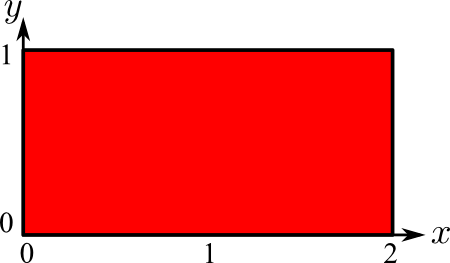
Solution: We will compute the double integral equally the iterated integral \begin{marshal*} \int_0^1 \left( \int_0^2 xy^2 dx\right) dy. \end{marshal*} We get-go integrate with respect to $x$ inside the parentheses. Similar to the process with partial derivatives, we must treat $y$ as a constant during this integration step. Since for any constant $c$, the integral of $cx$ is $cx^2/two$, we calculate \begin{align*} \int_0^1 \left( \int_0^2 xy^2 dx\correct) dy &= \int_0^ane \left(\left. \frac{x^2}{ii} y^2 \right|_{10=0}^{x=two} \right)dy\\ &= \int_0^one \left( \frac{ii^2}{2} y^2 - \frac{0^2}{two} y^2 \right)dy \\ &= \int_0^1 two y^ii dy. \end{align*} Notation that in the offset line above, we wrote the limits as $x=two$ and $10=0$ and then it is unambiguous that $x$ is the variable we merely integrated.
To finish, nosotros demand to compute the integral with respect to $y$, which is simple. Since $10$ is gone, it's just a regular 1-variable integral. Nosotros calculate that our double integral is \begin{align*} \iint_\dlr x y^2 dA &= \int_0^1 two y^2 dy\\ &= \left. \frac{2y^3}{3} \correct|_0^1 \goodbreak = \frac{2(1^three)}{3}- \frac{2(0^3)}{3} \goodbreak =\frac{2}{3}. \cease{align*}
To double cheque our answer, nosotros can compute the integral in the other management, integrating first with respect to $y$ and and so with respect to $x$. The only play tricks is to think that when integrating with respect to $y$, we must think of $10$ as a constant. Since for whatever constant $c$, the integral of $cy^2$ is $cy^3/3$, nosotros calculate \begin{align*} \iint_\dlr ten y^2 dA &= \int_0^2 \left( \int_0^i xy^2 dy\right) dx\\ &= \int_0^two \left(\left. x \frac{y^three}{iii} \right|_{y=0}^{y=1}\correct)dx\\ &= \int_0^two \frac{10}{3} dx\\ &= \left.\left.\frac{10^2}{vi} \right|_0^ii\right. = \frac{4}{6} = \frac{2}{3}. \end{align*} Every bit it must, this iterated integral gives the aforementioned answer.
Case 2
Rectangular regions are easy because the limits ($a \le x \le b$ and $c \le y \le d$) are stock-still, meaning the ranges of $10$ and $y$ don't depend on each other. For regions of other shapes, the range of ane variable will depend on the other. Here'southward an instance where we integrate over the region defined past $0 \le 10 \le 2$ and $0 \le y \le 10/2$. The fact that the range of $y$ depends on $10$ means this region is not a rectangle. In fact, the region is the triangle pictured below.
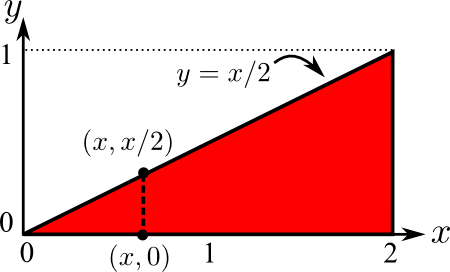
Using the same role $f(ten,y)=xy^2$ as in instance i, compute $\iint_\dlr f\,dA$ where $\dlr$ is the above triangle.
Solution: A triangle is slightly more complicated than a rectangle because the limits of one variable will depend on the other variable. For the triangle defined past $0 \le ten \le two$ and $0 \le y \le x/2$, the limits of $y$ depend on $x$. For a given value of $x$, $y$ ranges from 0 to $x/ii$, as illustrated higher up past the vertical dashed line from $(x,0)$ to $(x,x/2)$.
In a double integral, the outer limits must be abiding, but the inner limits can depend on the outer variable. This means, we must put $y$ as the inner integration variables, as was done in the second way of computing Example ane. The only difference from Example 1 is that the upper limit of $y$ is $x/two$. The double integral is \begin{align*} \iint_\dlr x y^2 dA &= \int_0^2 \left(\int_0^{ten/2} xy^two dy \right) dx\\ &=\int_0^ii \left(\left.\frac{x}{3} y^three \right|_{y=0}^{y=x/two}\right) dx\\ &=\int_0^two \left( \frac{x}{3} \left(\frac{ten}{two}\right)^3 -\frac{x}{3} 0^3 \right) dx\\ &= \int_0^two \frac{10^4}{24} dx\\ &= \left.\left.\frac{x^5}{v\cdot 24}\right|_0^ii\right. = \frac{32}{v \cdot 24} = \frac{iv}{fifteen}. \end{align*}
Case 2'
Now compute the integral over the same triangle $\dlr$, only make $y$ be the outer integration variable.
Solution: Now we demand to requite constant limits for $y$. Equally illustrated below, the full range of $y$ inside the triangle is betwixt betwixt $0$ and $ane$. Then, for a given value of $y$, $10$ takes on values between $2y$ and $2$ (every bit shown by the horizontal dashed line between $(2y,y)$ and $(2,y)$). Hence, we can depict the triangle by $0 \le y \le 1$ and $2y \le x \le ii$.
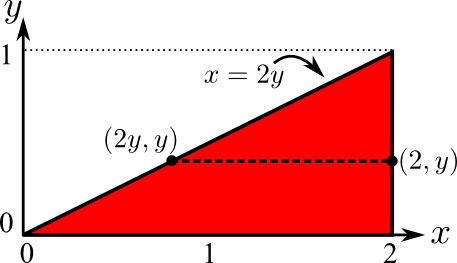
Is it confusing that the limits of $x$ are $2y \le ten \le ii$ rather than $0 \le x \le 2$ (which would more than closely parallel the to a higher place Example 2)? If we let $ten$ range from $0$ to $2y$, and then the triangle would be the upper-left triangle in the in a higher place motion picture. We want to compute the integral over the region $\dlr$, which is the lower-correct triangle shaded in red. In this triangle, $y \lt 10/2$ (equally used above in Example 2) which ways that for this case, we must employ $x > 2y$.
The double integral is similar to the get-go way of computing Instance 1, with the only difference being that the lower limit of $x$ is $2y$. The integral is \brainstorm{align*} \iint_\dlr x y^2 dA &= \int_0^1 \left( \int_{2y}^2 xy^2 dx \right)dy\\ &= \int_0^one\left(\left.\frac{x^2y^2}{2} \correct|_{10=2y}^{x=2}\right) dy\\ &= \int_0^1 \left( 2y^2 - \frac{(2y)^ii y^2}{two}\right) dy\\ &= \int_0^1 \left( 2y^2 - 2y^four\right) dy\\ &= 2 \left[ \frac{y^three}{3} - \frac{y^v}{5} \right]_0^1\\ &= 2 \left(\frac{1}{three} - \frac{1}{5} -(0-0)\right)\\ &= 2 \cdot \frac{2}{15} \goodbreak = \frac{4}{15}. \end{marshal*} Thankfully, this does hold with the respond we obtained in Example 2.
More examples
To get from Example 2 to Example two', we "changed the order of integration." You can come across more than examples of changing the order of integration in double integrals. Y'all can also see more double integral examples from the special cases of interpreting double integrals as area and double integrals as volume.

Source: https://mathinsight.org/double_integral_examples
Posted by: wilkeswhoundle.blogspot.com
0 Response to "How To Draw Lines For Double Integrals"
Post a Comment